
Blog
Types of Car Suspension Explained
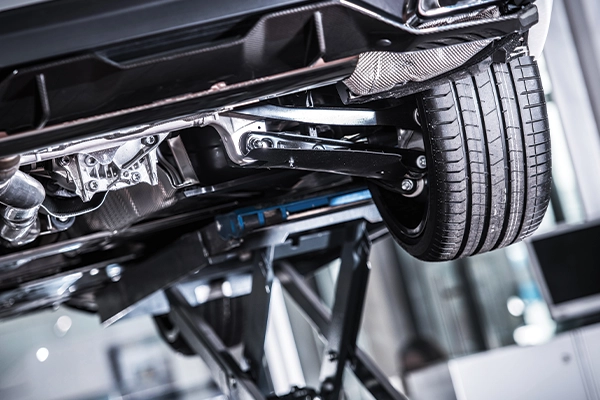
Your vehicle’s suspension system does much more than make your ride comfortable. It helps keep the tires in contact with the road, supports the vehicle’s weight, controls body movement, and plays an important role in steering, braking, and handling.
There are several different types of car suspension systems, and each design has its own advantages. Understanding the differences can make it easier to recognize what your vehicle has and why a suspension problem can affect the way your car drives.
What Does a Car Suspension System Do?
A suspension system connects the wheels to the vehicle while allowing them to move over bumps, potholes, and uneven surfaces. Springs support the vehicle’s weight, while shocks or struts control the movement of the suspension.
Shocks and struts are especially important because they help control bouncing, body roll, brake dive, and acceleration squat. They also help maintain consistent tire contact with the road.
The overall suspension design determines how the wheels move and how the vehicle responds to different road conditions.
MacPherson Strut Suspension
MacPherson strut suspension is one of the most common suspension designs found on modern cars, particularly on the front of many front-wheel-drive vehicles.
A MacPherson strut combines several suspension functions into one assembly. The strut provides damping while also serving as a structural component of the suspension. It typically works with a coil spring, steering knuckle, and lower control arm.
One major advantage of this design is its relatively compact size. It takes up less space than some other independent suspension arrangements, making it useful in vehicles where engineers need to maximize room in the engine compartment.
If your vehicle uses front struts, worn struts can affect ride quality, steering, braking, alignment, and tire wear.
Double Wishbone Suspension
Double wishbone suspension uses two control arms, commonly called upper and lower control arms, to locate the wheel.
This design gives engineers considerable control over wheel movement and suspension geometry. It can provide excellent handling characteristics because the suspension can be designed to maintain desirable wheel angles as the vehicle moves through corners and over bumps.
Double wishbone suspension is commonly associated with performance-oriented vehicles, trucks, SUVs, and vehicles where precise handling is important.
The tradeoff is complexity. Compared with a basic strut arrangement, double wishbone suspension generally requires more components and space.
Multi-Link Suspension
Multi-link suspension uses several separate links to control the movement of the wheel.
Instead of relying on one or two large control arms to manage multiple suspension movements, each link can be designed to control a specific aspect of wheel movement. This gives vehicle engineers considerable flexibility when balancing ride comfort, handling, and stability.
Multi-link suspension is commonly found on modern cars, particularly on vehicles where manufacturers want a combination of comfortable road manners and responsive handling.
Because the system contains multiple links, bushings, and joints, there are more components that can eventually wear out.
Torsion Beam Suspension
A torsion beam, sometimes called a twist-beam rear suspension, is a common rear suspension design on many compact and economy cars.
The rear wheels are connected by a beam that allows controlled movement between the wheels. The design is relatively simple and compact, which can help manufacturers reduce weight, cost, and packaging requirements.
One advantage of a torsion beam is its simplicity. There are generally fewer moving components than with a more complex independent rear suspension.
The tradeoff is that the wheels do not move completely independently. This can affect how the vehicle responds to certain road surfaces and cornering conditions.
Leaf Spring Suspension
Leaf springs have been used on vehicles for generations and remain common on many trucks and commercial vehicles.
A leaf spring consists of long, flexible strips of spring steel mounted between the vehicle and axle. The springs support the vehicle while allowing the axle to move as the vehicle travels over uneven surfaces.
Leaf springs are particularly useful for vehicles designed to carry heavy loads. Their simple and durable construction makes them well suited to pickups, work trucks, and other applications where load capacity matters.
Air Suspension
Air suspension replaces traditional steel coil springs with air springs. The air springs use pressurized air to support the vehicle, while a compressor, valves, sensors, and other components manage the system.
One of the biggest advantages of air suspension is adjustability. Depending on the vehicle, the system can raise or lower ride height and adjust the suspension based on vehicle load or driving conditions.
Air suspension is commonly found on luxury vehicles, certain trucks and SUVs, and vehicles designed for towing or heavy loads.
Because air suspension relies on additional components such as compressors, air lines, valves, and sensors, repairs can be more involved than conventional spring and shock repairs.
Which Type of Suspension Does My Car Have?
The suspension design depends on your vehicle’s make, model, year, drivetrain, trim level, and intended use. Some vehicles even use different suspension designs on the front and rear.
You can usually find information about your suspension system in the vehicle service information, but a qualified technician can also identify the system during an inspection.
Regardless of the design, worn suspension components should be addressed before they begin affecting handling, braking, tire wear, or vehicle stability.
Signs Your Suspension Needs Attention
A suspension inspection may be appropriate if you notice:
- Excessive bouncing after hitting a bump
- The vehicle pulling or drifting while driving
- Uneven or rapid tire wear
- Vehicle leaning to one side
- Excessive body roll during turns
- Nose-diving during braking
- Clunking or knocking noises
- A noticeably rough or uncomfortable ride
- Fluid leaking from a shock or strut
- Uneven vehicle ride height
Some of these symptoms can also be caused by tires, steering components, wheel alignment, or braking problems. A proper inspection can help identify the actual source.
Suspension Services in the Salt Lake Valley
Your suspension system is responsible for much more than ride comfort. Whether your vehicle uses MacPherson struts, double wishbones, multi-link suspension, a torsion beam, leaf springs, or air suspension, every component needs to work together properly.
If your car has started bouncing, pulling, leaning, or making unusual suspension noises, have it inspected by the trusted team at Alex’s Autohaus in Midvale, UT. Our technicians have extensive training and experience in providing high-quality maintenance and repair on the suspension systems of various European makes and models. No matter what type of suspension your vehicle has, give us a call or schedule online to secure your appointment with Midvale’s premier suspension repair facility.

Nationwide Warranty
3 YEAR, 36,000 MILE
Alex’s Autohaus offers our customers the Tech-Net Peace of Mind Nationwide Warranty, which is honored at over 10,000 service centers across the country. Our warranty covers workmanship for 36 months or 36,000 miles, whichever comes first. Parts are covered under their respective manufacturer-specified warranties, which can vary.